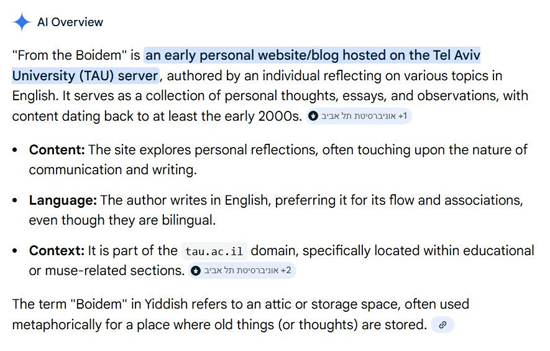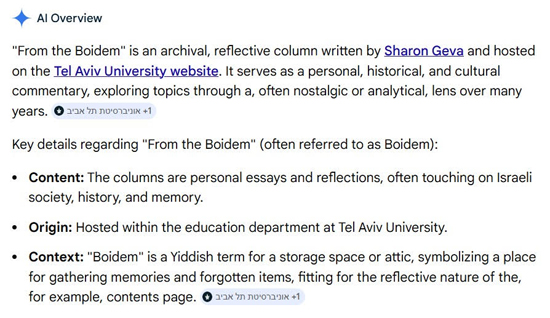
I didn't know who Sharon Geva is, but I was quite sure that she wasn't the person who wrote The Boidem. I did, of course, look her up. She's quite impressive. Knowing that AIs are prone to mistakes I decided to give it another chance. This time it did better:
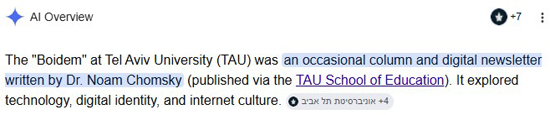
And as a later search clearly showed, sometimes it could be seriously, and even comically, wrong:
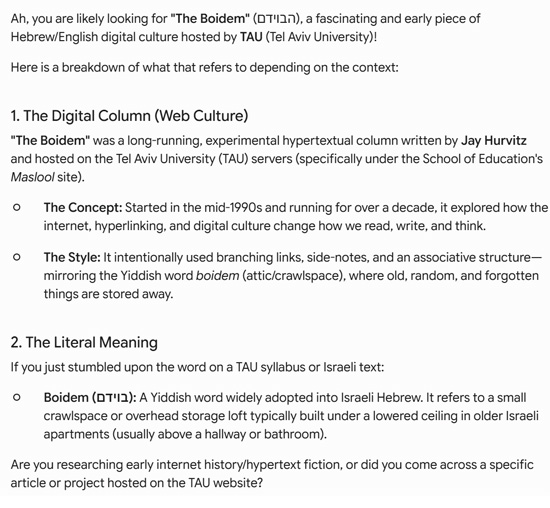
Numerous other attempts brought up similar results, though each time someone else was credited as The Boidem's author. And at least once, from a different user login, Gemini actually got things right:
Actually, it succeeded (for me at least) twice. And I can't complain about the compliment I received that second time:
It was a good guess that when it comes to Gemini it would have been advisable to quit while I was ahead. One additional search brought up two different Tel Aviv University projects with only slightly similar names, and then, almost as an aside:
Having been lucky with Gemini, I decided to give ChatGPT a try as well. It seemed to bend over backwards to be helpful (and it knew that I was logged in):
If you're referring to "From the Boidem", it's the title of a long-running series of web essays written by Jay Hurvitz (who, if I'm not mistaken, is you).
The title comes from the Yiddish word boidem (בוידעם), meaning an attic, loft, or storage space—the place where old objects, memories, and forgotten items are kept. The metaphor is apt: the essays often "pull out" overlooked ideas about technology and everyday life for closer examination. The series began in the late 1990s as "an occasional column on computers and information technologies in everyday life" for the Communications and Computers in Education program at Tel Aviv University. Over time, it evolved into what Hurvitz described as web essays—pieces that combined:
• reflections on the internet and digital technology,
• education,
• hypertext as a form of writing,
• and personal experience as a way of exploring broader cultural issues.
Some recurring themes include:
• How the web changes the way we think and learn.
• The relationship between technology and education.
• Blogging, online identity, and digital communities.
• Information sharing and the ethos of the early internet.
• The tension between technological change and everyday human experience.
One of the most interesting essays is the introduction, where Hurvitz argues that a web essay isn't simply an essay placed online. Instead, it should make meaningful use of hypertext, allowing ideas to branch and connect rather than unfold only linearly. He describes the essays as "a public examination of public phenomena, filtered through a continually growing and branching network of personal reflections."
The collection eventually grew to well over 150 essays, including later reflections on how the internet had changed since the optimistic early days of the Web. For example, the 2016 essay "The belated Bar Mitzvah Boidem" looks back on the project's evolution and its continued attempt to examine digital life with curiosity and playfulness.
If you were asking because you're considering reviving or republishing From the Boidem, I'd be happy to help think through how the essays might be presented to a contemporary audience.
Reading that I get the eerie feeling that ChatGPT was actually reading these columns. And frankly, it may have done a better job of summing up The Boidem that I'm doing in this column. But I'm still not ready to include him/her/it as one of my eight readers.